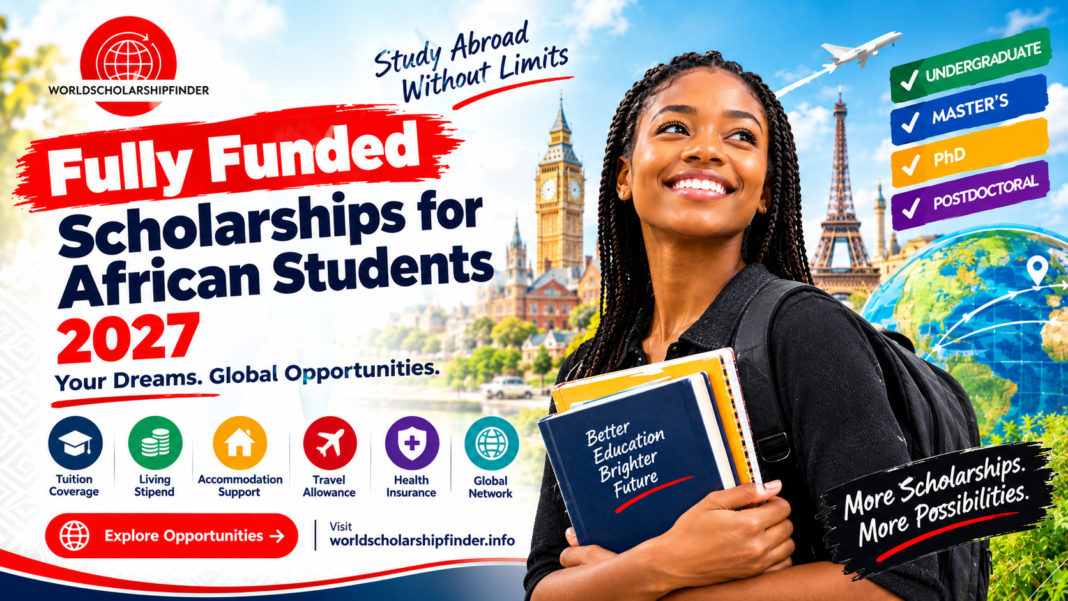
Fully Funded Scholarships for African Students 2027
For many students across Africa, studying at a leading university abroad can be difficult because of tuition fees, accommodation, travel, health insurance, and daily living costs. Fully funded scholarships for African students 2027 can help remove many of these financial barriers and make international education more accessible.
Government agencies, universities, foundations, and international organisations offer scholarships for African students at undergraduate, master’s, PhD, and research levels. Some opportunities are open to students from many African countries, while others are limited to specific nationalities, fields, or development priorities.
This guide covers scholarships for African students, including major 2027 opportunities in the UK, Canada, Australia, Europe, Asia, and other destinations.
Important: Scholarship deadlines, eligible countries, courses, and funding conditions can change. Always verify the latest information on the official provider’s website before applying.
What Are Fully Funded Scholarships?
A fully funded scholarship is an award designed to cover most or all of the major costs associated with an approved programme of study.
Depending on the scholarship, funding may include:
- Full or partial tuition fees
- Monthly living allowance
- Accommodation or housing support
- Return international airfare
- Health insurance
- Visa-related support
- Study or research allowances
- Books and academic materials
- Fieldwork funding
- Travel allowances
- Orientation or preparatory programmes
“Fully funded” does not mean that every scholarship covers every personal expense.
The exact benefits depend on the provider, university, country, programme, and scholarship conditions.
For example, Commonwealth Master’s Scholarships cover approved tuition fees, airfare, and a living allowance, with additional support depending on the award.
Key Fully Funded Scholarships for African Students 2027
The opportunities below have official 2027 information available or are established programmes with an officially announced 2027 cycle.
| Scholarship | Host Country | Study Level | Funding | Eligible Students | Deadline |
|---|---|---|---|---|---|
| Chevening Scholarships 2027–28 | UK | Master’s | Full financial support for eligible scholars | Applicants from eligible African countries and other participating countries | 6 October 2026 |
| Commonwealth Master’s Scholarships 2027/28 | UK | Master’s | Tuition, airfare, living allowance and other approved support | Citizens/residents of eligible Commonwealth low- and middle-income countries | 20 October 2026, 16:00 BST; nominator deadlines may be earlier |
| Erasmus Mundus Joint Masters | Europe and partner countries | Master’s | Full scholarships may cover participation costs and contribute to travel, visa and living costs | Students worldwide, subject to programme eligibility | Usually October–January, programme-specific |
| Gates Cambridge Scholarship 2027/28 | UK | Master’s/PhD and eligible postgraduate routes | Full-cost postgraduate funding package | Eligible applicants from outside the UK | 8 December 2026 or 6 January 2027, depending on course |
| Clarendon Fund | UK | Master’s/DPhil | Full course fees plus living support | International and UK applicants to eligible Oxford graduate courses | Course-specific December/January deadline |
| Australia Awards Africa | Australia | Master’s and selected professional programmes | Tuition, airfare, living support, health cover and other benefits | Citizens of specified African countries | 30 April 2026 for the 2027 intake; that round is closed |
| GKS 2027 | South Korea | Undergraduate and graduate routes | Scholarship support varies by programme and track | Applicants from participating countries, subject to annual quota | Track/country/university-specific |
| Mastercard Foundation Scholars Program at UBC | Canada | Master’s | Comprehensive scholarship support for eligible scholars | African citizens/refugees meeting programme and academic requirements | Programme-specific; 2027 cycle opened in 2026 |
| Mastercard Foundation Scholars Program at McGill | Canada | Master’s | Tuition, housing, stipend and academic support | Citizens/residents of African countries in eligible programmes | 1 December 2026 for pre-screened applicants with fee waiver |
Chevening’s 2027–28 application window opened on 4 August 2026 and closes at 11:00 UTC on 6 October 2026. Chevening country pages confirm participation for countries including Ghana, Kenya, Nigeria, Angola and the Democratic Republic of the Congo.
The Commonwealth Master’s Scholarship 2027/28 application opened on 8 September 2026 and closes on 20 October 2026. The official eligibility list includes African countries such as Ghana, Kenya, Nigeria, Rwanda, Sierra Leone, South Africa, Tanzania, Uganda and Zambia.
Erasmus Mundus Joint Masters are open to students worldwide, but each master’s consortium sets its own admission requirements and application deadline. The European Commission says applications are usually submitted between October and January for programmes beginning the following academic year.
For Cambridge, the University’s 2027/28 funding deadlines include 8 December 2026 and 6 January 2027, depending on the course.
Scholarships for African Students by Study Level
Undergraduate Scholarships for African Students
Fully funded undergraduate scholarships are available, although they are generally more limited than postgraduate opportunities.
Students should investigate:
- Government scholarship programmes
- University scholarships
- Foundation-funded programmes
- Leadership scholarships
- International undergraduate programmes
- Country-specific government awards
The 2027 Global Korea Scholarship Undergraduate Programme has been officially announced by the Korean government, with the university-track notice published in September 2026. Applicants should follow the current GKS guidelines and the participating university’s requirements.
African students should also check university-based funding because some awards are available only to applicants admitted to particular institutions or degree programmes.
Master’s Scholarships for African Students
Master’s applicants have a particularly wide range of international scholarship options.
Important programmes include:
- Chevening Scholarships
- Commonwealth Master’s Scholarships
- Erasmus Mundus Joint Masters
- Australia Awards Africa
- Gates Cambridge
- Oxford Clarendon
- Mastercard Foundation Scholars Program
- University-specific scholarships
Chevening is specifically designed for eligible international applicants pursuing master’s study in the UK. The 2027–28 cycle is currently open, with the application deadline of 6 October 2026.
The Commonwealth Master’s Scholarship is another major route for eligible African citizens of Commonwealth countries. Applicants must satisfy both the CSC requirements and any requirements set by their nominating agency.
PhD Scholarships for African Students
PhD applicants can find funding through:
- Government scholarships
- University doctoral scholarships
- Research assistantships
- Research council funding
- International foundations
- Joint doctoral programmes
- Research fellowships
The Gates Cambridge Scholarship supports eligible postgraduate study at Cambridge and is available to applicants from countries outside the UK. Course-specific funding deadlines apply.
Oxford’s Clarendon Fund also considers applicants for eligible Master’s and DPhil programmes. Applicants who submit their graduate application by the relevant December or January deadline are automatically considered for Clarendon funding.
Postdoctoral Opportunities
Postdoctoral funding is usually more specialised than degree scholarships.
African researchers should monitor:
- African Academy of Sciences programmes
- NIH Fogarty fellowships
- University research fellowships
- International research foundations
- European research fellowships
- Government research programmes
For example, the NIH Fogarty International Center announced the 2027–2028 Fogarty Global Health Fellows programme for doctoral and postdoctoral trainees. Eligibility depends on the specific consortium, and the programme includes African countries such as Cameroon, Ghana, Kenya and Uganda in the relevant 2027 call.
Applicants should distinguish a postdoctoral fellowship from a postgraduate degree scholarship. A postdoctoral award normally requires an existing PhD.
Scholarships by Destination
United Kingdom
The UK remains a major destination for international scholarships for African students.
Key programmes include:
- Chevening
- Commonwealth Master’s Scholarships
- Commonwealth PhD Scholarships
- Commonwealth Shared Scholarships
- Gates Cambridge
- Oxford Clarendon
- University-specific awards
The Commonwealth Scholarship Commission confirms that its scholarships cover approved tuition and, for UK-based awards, airfare and living support.
United States
African students can explore:
- Fulbright Foreign Student Program
- University-funded graduate scholarships
- Research assistantships
- Departmental fellowships
- Foundation scholarships
U.S. scholarship eligibility can vary significantly by nationality. Students should use the Fulbright country page or university funding page applicable to their citizenship.
Canada
Canada has several university-based funding routes for African students.
The Mastercard Foundation Scholars Program is particularly relevant.
At UBC, the Mastercard Foundation graduate programme requires applicants to be citizens or refugees of an African country, have completed a bachelor’s degree, meet programme requirements, and satisfy the stated age and academic criteria.
At McGill, the Mastercard Foundation Scholars Program is designed for talented leaders from across Africa pursuing eligible master’s programmes. Its published benefits include international tuition, housing, a monthly stipend, academic resources, and leadership support.
Australia
Australia Awards Africa is one of the most important government-funded programmes specifically connected to African development.
The programme supports master’s study and professional development for eligible applicants from participating African countries. Benefits include full tuition, return airfare, a contribution to living expenses, health cover, and other support.
The participating African countries for the 2027 intake included Algeria, Angola, Botswana, Côte d’Ivoire, the Democratic Republic of the Congo, Egypt, Ethiopia, The Gambia, Ghana, Guinea, Kenya, Madagascar, Malawi, Mauritius, Morocco, Mozambique, Namibia, Nigeria, Rwanda, Sierra Leone, South Africa, Tanzania, Uganda, Zambia and Zimbabwe.
The 2027 Africa intake closed on 30 April 2026, so students preparing for a future cycle should monitor the official Australia Awards website for the next opening.
Germany
Germany is an important destination for African postgraduate students.
Students should investigate:
- DAAD scholarships
- University research positions
- Development-related postgraduate programmes
- University doctoral funding
- Research fellowships
DAAD programmes often have course-specific eligibility and deadlines, so applicants should check the individual programme rather than assuming that every DAAD scholarship has the same requirements.
France
African students can investigate French government and university funding, including Eiffel-related opportunities and university scholarships.
However, applicants should distinguish between a scholarship that provides a substantial stipend and one that covers every cost. Read the official funding conditions carefully before describing an award as fully funded.
Netherlands
Dutch universities and government-supported programmes provide scholarships for international students.
Opportunities may include:
- University scholarships
- Research scholarships
- Master’s funding
- PhD positions
- Institution-funded research employment
Many Dutch PhD opportunities operate more like paid research positions than traditional scholarships.
Türkiye
Türkiye offers government-funded scholarship programmes for international students through Türkiye Scholarships.
Applicants should check the current programme database because eligible nationalities, academic requirements, degree levels, and application periods can differ.
Japan
The Japanese government’s MEXT scholarship is an important route for African students.
MEXT has several categories, including undergraduate and research-related routes. Application procedures can differ depending on whether an applicant applies through an embassy or a university.
China
Chinese universities and government scholarship programmes offer funding for international students at different academic levels.
African applicants should investigate both national scholarship programmes and university-level awards.
South Korea
South Korea offers government and university scholarships for international students.
The Global Korea Scholarship is one of the most important options. The Korean government’s official scholarship notice system has already published 2027 undergraduate programme announcements.
Hungary
Hungary’s Stipendium Hungaricum programme is another opportunity African students can investigate.
Eligibility depends on the sending-partner arrangement and the current programme list. Applicants should confirm whether their country and preferred field are included in the current call.
Scholarships for Students From Specific African Countries
Not every scholarship accepts applicants from every African country.
This is one of the most important points to understand when searching for fully funded scholarships for Africans.
For example:
- Ghanaian students: Chevening and Commonwealth opportunities are available where Ghana appears on the relevant eligibility list. Australia Awards Africa also listed Ghana for the 2027 intake.
- Kenyan students: Kenya is listed for Chevening, Commonwealth Master’s Scholarships, and Australia Awards Africa.
- Nigerian students: Nigeria is listed for Chevening and Commonwealth Master’s Scholarships, as well as Australia Awards Africa.
- South African students: South Africa appears on the Commonwealth Master’s eligibility list and Australia Awards Africa list, but individual programmes can impose additional conditions.
- Rwandan students: Rwanda is included in both Commonwealth Master’s eligibility and the Australia Awards Africa participating-country list.
These examples do not mean that every scholarship listed in this article accepts applicants from these countries.
Always check the nationality requirements for the specific scholarship.
What Do Fully Funded Scholarships Cover?
A fully funded scholarship may provide some or all of the following:
Tuition Fees
The scholarship may pay the approved tuition charged by the university.
Living Allowance
Many scholarships provide a monthly stipend for expenses such as food, accommodation, transport, and other basic needs.
Travel
Some awards provide return airfare or a travel allowance.
Accommodation
Accommodation may be provided directly or supported through a housing allowance.
Health Insurance
Some government scholarships include health insurance or medical coverage.
Research Support
PhD and research students may receive funding for fieldwork, conferences, research travel, or academic materials.
Do not assume that a scholarship covers expenses that are not listed in its official terms.
Common Eligibility Requirements
Requirements vary, but applicants commonly need:
- Citizenship of an eligible country
- Relevant academic qualification
- Strong academic record
- Admission or eligibility for an approved programme
- Relevant professional experience for some scholarships
- Leadership or community involvement for selected awards
- Research proposal for some PhD programmes
- English-language evidence where required
- Age requirements where applicable
- Compliance with field-of-study restrictions
- Intention to meet scholarship conditions after graduation
For example, Commonwealth Master’s applicants must meet the CSC’s eligibility rules as well as any additional requirements set by their nominating agency.
Australia Awards Africa also has country-specific conditions, including professional and work-experience requirements for its relevant programmes.
Documents Required
Prepare the following documents early:
- Valid passport or national identification
- Academic certificates
- Academic transcripts
- Updated CV
- Motivation letter or personal statement
- Recommendation letters
- Proof of employment or work experience
- English-language test result, if required
- Medium-of-Instruction evidence, where accepted
- Research proposal for relevant PhD programmes
- University admission documents
- Portfolio for creative programmes
- Proof of citizenship
- Scholarship-specific forms
- Financial or socioeconomic documents where requested
Some documents may require official certification or translation.
How African Students Can Apply
1. Choose Your Study Level
Decide whether you are applying for undergraduate, master’s, PhD, or postdoctoral funding.
2. Choose Your Field
Scholarships may prioritise areas such as:
- Agriculture
- Public health
- Engineering
- Climate change
- Energy
- Technology
- Education
- Economics
- Public policy
- Development studies
- Science and research
3. Check Your Nationality
Do not assume that a scholarship is open to all African countries.
Check the official eligible-country list.
4. Check the Academic Requirements
Compare your degree, grades, work experience, research background, and other qualifications with the scholarship criteria.
5. Check the University Requirements
Scholarship eligibility and university admission are not always the same.
You may need to apply separately to a university.
6. Prepare Your Documents
Request transcripts, references, certificates, and other documents early.
7. Write a Specific Application
Explain your academic goals, professional experience, leadership, community involvement, and how the programme fits your long-term plans.
Do not send the same generic statement to every scholarship.
8. Submit Before the Deadline
Keep a scholarship calendar with:
- Opening date
- Deadline
- University deadline
- Scholarship deadline
- Nomination deadline
- Interview date
- Required documents
- Application status
World Scholarship Finder’s scholarship application guide also recommends organising opportunities by study level, country, funding type, and deadline.
How to Find Legitimate Scholarships
The safest sources are:
- Government scholarship agencies
- Official embassy websites
- University websites
- Recognised foundations
- International organisations
- Official scholarship portals
- Established academic institutions
Be careful with websites that promise:
- Guaranteed scholarships
- Guaranteed admission
- Guaranteed visas
- Scholarships for everyone
- Selection without academic requirements
- Scholarships available only after paying an “application agent”
- Unverified bank-account payment requests
A legitimate scholarship should have identifiable eligibility requirements and an official application process.
World Scholarship Finder can help students discover opportunities, but applicants should always verify the final details with the official scholarship provider or university. The site maintains dedicated sections for undergraduate, master’s/postgraduate, PhD, and study-abroad opportunities.
Common Scholarship Application Mistakes
Avoid these common problems:
Missing the Deadline
Some scholarship systems close automatically.
Ignoring Country Restrictions
A scholarship may be advertised as international but have a limited eligible-country list.
Applying for the Wrong Study Level
Do not apply for a master’s scholarship if you have not completed the required undergraduate qualification.
Using a Generic Personal Statement
Your statement should connect your background with the specific programme and scholarship.
Ignoring University Deadlines
A scholarship deadline may not be the same as the university admission deadline.
Submitting Incomplete Documents
Missing transcripts, references, or certificates can make an otherwise strong application ineligible.
Trusting Old Scholarship Information
A scholarship can change its deadline, funding, eligible countries, or application method from one year to another.
Always check the latest official announcement.
FAQs
1. What are the best fully funded scholarships for African students in 2027?
Major 2027 opportunities include Chevening, Commonwealth Master’s Scholarships, Erasmus Mundus Joint Masters, Gates Cambridge, Oxford Clarendon, Australia Awards Africa, GKS, and selected Mastercard Foundation programmes. Eligibility differs by country and programme.
2. Can African students get fully funded scholarships abroad?
Yes. Government agencies, universities, foundations, and international organisations offer fully funded or comprehensive scholarships to eligible African students.
3. Which scholarships are available for African students in 2027?
Examples include Chevening, Commonwealth Master’s Scholarships, Erasmus Mundus, Gates Cambridge, Clarendon, GKS, Australia Awards Africa, and selected Mastercard Foundation programmes.
4. Are there fully funded undergraduate scholarships for African students?
Yes, although undergraduate opportunities are generally more limited than postgraduate funding. Students should check government programmes, university scholarships, and foundation-funded awards.
5. Are there master’s scholarships for African students?
Yes. Master’s students can explore Chevening, Commonwealth Master’s Scholarships, Erasmus Mundus, Australia Awards Africa, Gates Cambridge, Mastercard Foundation programmes, and university-specific scholarships.
6. Are there PhD scholarships for African students?
Yes. African PhD applicants can investigate Gates Cambridge, Clarendon DPhil funding, Commonwealth PhD opportunities where eligible, university doctoral funding, research assistantships, and specialist research fellowships.
7. Can students from every African country apply for these scholarships?
No. Eligibility depends on the scholarship. Some programmes accept applicants from many African countries, while others have specific nationality lists, nomination rules, or country quotas.
8. When should African students start applying for 2027 scholarships?
Start as early as possible. Many 2027 scholarships have deadlines in late 2026 or early 2027. Documents such as transcripts, references, admission applications, and English-language evidence can take time to prepare.
Conclusion
Fully Funded Scholarships for African Students 2027 can provide a pathway to undergraduate, master’s, PhD, and research opportunities around the world.
The most important step is to match your nationality, academic level, field of study, experience, and career goals with the right scholarship.
Start with official sources. Check the eligible-country list. Read the funding conditions. Track both university and scholarship deadlines. Most importantly, never rely on an old deadline or an unverified social-media post.
For more opportunities, use the World Scholarship Finder scholarship resources and regularly check for newly announced 2027 calls.
Find more opportunities
- World Scholarship Finder Scholarships
- Undergraduate Scholarships
- Master’s & Postgraduate Scholarships
- Study Abroad Scholarships
- Scholarships Without IELTS 2027
- Fully Funded Scholarships for International Students
Official links
- Chevening 2027–28 Application Timeline
- Chevening Scholarships by Country
- Commonwealth Master’s Scholarships 2027/28
- Commonwealth Scholarship Funding FAQ
- Erasmus Mundus Joint Masters
- Gates Cambridge / Cambridge postgraduate funding deadlines
- Oxford Clarendon Scholarships
- Australia Awards Africa
- Australia Awards participating countries
- Global Korea Scholarship notices
- Mastercard Foundation Scholars Program at UBC
- Mastercard Foundation Scholars Program at McGill
- NIH Fogarty 2027–2028 Global Health Fellows information

