
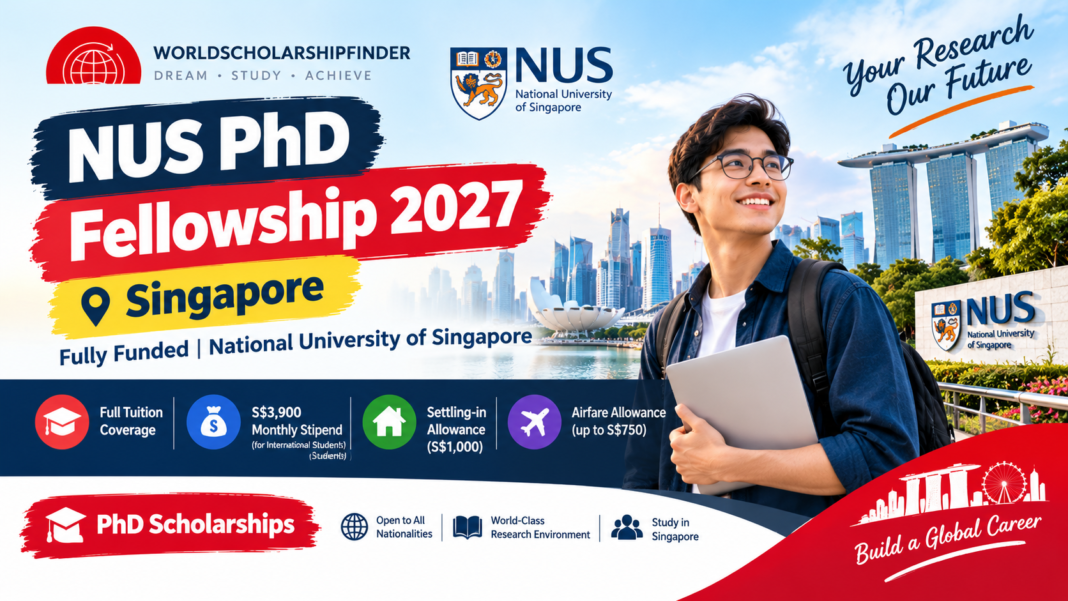
NUS President’s Graduate Fellowship 2027 in Singapore | Fully Funded PhD Scholarship
Are you planning to pursue a PhD in Singapore? The National University of Singapore (NUS) President’s Graduate Fellowship 2027 is a prestigious funding opportunity for outstanding doctoral researchers from Singapore and around the world.
The fellowship supports students pursuing research-based PhD programmes at NUS. Successful international applicants can receive full tuition coverage, a monthly stipend of S$3,900, a one-time settling-in allowance, and airfare support, subject to the official terms and conditions.
Unlike scholarships that require a separate public competition for every award, the President’s Graduate Fellowship is awarded through a university nomination process. Applicants must first meet the admission requirements of their chosen PhD programme and demonstrate strong academic and research potential.
If you are interested in pursuing doctoral research in Singapore, this guide explains the fellowship benefits, eligibility requirements, required documents, and application process for the 2027 intake.
NUS President’s Graduate Fellowship 2027: Overview
| Scholarship detail | Information |
|---|---|
| Scholarship name | President’s Graduate Fellowship (PGF) |
| Host university | National University of Singapore |
| Host country | Singapore |
| Study level | PhD |
| Eligible nationalities | Singapore citizens, permanent residents, and international students |
| Funding type | Full tuition coverage and monthly stipend |
| Monthly stipend for international students | S$3,900 |
| Monthly stipend for Singapore permanent residents | S$4,400 |
| Monthly stipend for Singapore citizens | S$4,800 |
| Settling-in allowance | S$1,000 for eligible international students |
| Airfare allowance | Up to S$750 for eligible newly registered international students |
| Typical maximum duration | Up to four years, subject to renewal and applicable conditions |
| Application route | PhD admission and faculty or department nomination |
| Official application page | https://nusgs.nus.edu.sg/scholarships/presidents-graduate-fellowship |
The fellowship is open to all nationalities, but receiving an award is competitive. Applicants must demonstrate strong academic potential and a genuine interest in research.
What Is the NUS President’s Graduate Fellowship?
The President’s Graduate Fellowship is a prestigious award offered by the National University of Singapore to PhD candidates who demonstrate exceptional promise or accomplishment in research.
The fellowship aims to support talented researchers as they undertake doctoral studies at NUS. Candidates may be considered through the relevant faculty or department after applying for an eligible PhD programme.
The award is initially granted for one year and may be renewed each semester, subject to satisfactory academic progress and the university’s approval. The maximum fellowship period is generally four years.
International students are eligible, making the programme an opportunity for qualified applicants from countries around the world to pursue doctoral research in Singapore.
Benefits of the NUS President’s Graduate Fellowship 2027
The fellowship provides financial support to help selected doctoral students concentrate on their research.
1. Full tuition fee coverage
The fellowship covers full tuition fees at NUS in accordance with the official award terms. This reduces the tuition costs associated with pursuing a PhD.
2. Monthly living stipend
The monthly stipend depends on the recipient’s residency status.
| Recipient category | Monthly stipend |
|---|---|
| Singapore citizens | S$4,800 |
| Singapore permanent residents | S$4,400 |
| International students | S$3,900 |
The applicable rates are specified in the university’s fellowship terms. Singapore citizens may also receive eligible Central Provident Fund contributions in addition to their stipend.
3. One-time settling-in allowance
Eligible newly registered international students receive a one-time settling-in allowance of S$1,000 to help with initial expenses when moving to Singapore.
4. Air travel allowance
Eligible new international recipients may claim up to S$750 toward a one-way, economy-class ticket from their home country to Singapore to commence their studies.
Airfare claims must follow the university’s requirements and submission deadlines.
5. Additional research incentive
Eligible fellowship recipients may also qualify for the NUS Graduate School Research Incentive Award. Under the published terms, this includes an additional monthly allowance and a one-time research allowance after passing the PhD Qualifying Examination in the second year of candidature.
The university reserves the right to adjust the applicable additional allowance. Applicants should review the latest fellowship terms for details.
Important: The fellowship does not automatically cover every possible expense, such as return flights, all personal costs, or family expenses. Read the official terms before planning your budget.
Eligibility Requirements for NUS President’s Graduate Fellowship 2027
Applicants should satisfy the admission requirements for their selected PhD programme and meet the fellowship’s selection criteria.
1. Nationality
The fellowship is open to:
- Singapore citizens.
- Singapore permanent residents.
- International students of all nationalities.
International applicants must also meet the applicable student admission and immigration requirements.
2. Relevant academic qualifications
Applicants need an appropriate academic background, generally supported by a relevant bachelor’s or master’s degree, depending on the requirements of the doctoral programme.
NUS does not publish one universal GPA threshold for the President’s Graduate Fellowship on its central scholarship page. However, a good academic record is considered during assessment.
Meeting the basic admission requirements does not guarantee a fellowship.
3. Strong research potential
Candidates should demonstrate a keen interest in research and the ability to undertake advanced academic work.
Relevant evidence may include previous research projects, academic achievements, publications, or experience related to the proposed field of study.
4. Statement of purpose
Applicants must provide a statement explaining their research interests, academic motivations, career goals, and reasons for choosing the programme.
A clear, well-developed statement can help the university understand the applicant’s research direction and suitability.
5. Academic and professional references
Letters of recommendation from suitable academic or professional referees are part of the required application materials. These should provide meaningful information about the applicant’s qualifications and research potential.
6. English-language requirements
Do not assume that IELTS or TOEFL is unnecessary for every applicant. English-language requirements can vary by programme and applicant background.
Check the admission page for your intended PhD programme to determine whether an English-language test or alternative evidence of proficiency is required.
Required Documents
Prepare the documents requested by your selected NUS PhD programme and the relevant scholarship application process.
Commonly required materials include:
- Completed online application.
- Academic transcripts.
- Degree certificates or proof of qualifications.
- Statement of purpose.
- Curriculum vitae (CV).
- Letters of recommendation.
- Research proposal or description of research interests, where required.
- English-language test results, if applicable.
- GRE scores or other supporting test results, if required or relevant.
- Evidence of research experience, publications, or academic projects, where available.
- Passport or identification documents, as requested.
The exact document list can differ by faculty, department, and doctoral programme. Follow the instructions provided by your chosen programme rather than assuming every document applies to every applicant.
How to Apply for the NUS President’s Graduate Fellowship 2027
The fellowship is awarded through a nomination process. Applicants should begin by applying for admission to a suitable PhD programme at NUS.
Step 1: Find a suitable PhD programme
Visit the official NUS Graduate School website and explore the research programmes available in your academic field.
Choose a programme that matches your previous education, research interests, and career goals.
Step 2: Check the admission requirements
Review the relevant faculty or department’s requirements, including academic qualifications, language proficiency, supporting documents, and application deadlines.
PhD admission requirements and timelines vary across programmes.
Step 3: Prepare your application
Gather your academic transcripts, certificates, CV, statement of purpose, recommendation letters, and other required materials.
If your proposed research requires a research statement or proposal, make sure it follows the department’s instructions.
Step 4: Submit your PhD application
Apply through the university’s official graduate admission system and follow the scholarship instructions provided during the process.
Applicants may be considered for the fellowship through their faculty or department. The university states that excellent PhD applicants must be nominated by the relevant faculty or department.
Step 5: Complete any additional requirements
If you are assessed as eligible for consideration, the faculty or department will advise you on any additional fellowship procedures.
You may be asked to provide further information or complete additional steps.
Step 6: Wait for the outcome
NUS states that successful applicants are generally informed of the fellowship outcome around May for August admission or October for January admission. The timing can depend on the relevant intake and programme.
Successful candidates must sign the required letter of undertaking and comply with the fellowship terms and conditions.
Application Deadline for 2027
There is no single universal deadline for every NUS President’s Graduate Fellowship application listed on the central scholarship page.
The relevant application period depends on the intended intake and the faculty or department offering the PhD programme. The university lists August and January admission periods and directs applicants to the relevant faculty websites for their application deadlines.
Do not rely on 15 June 2027 as a confirmed fellowship deadline unless that date is published by the relevant NUS faculty or department for your chosen programme.
To avoid missing an opportunity, check the official scholarship page and the admission deadline for your intended PhD programme.
Why Study at the National University of Singapore?
The National University of Singapore is a major research university offering doctoral programmes across a wide range of academic fields.
Studying at NUS can provide opportunities to work with academic supervisors, use university research facilities, and participate in a research environment in Singapore.
Before applying, investigate the faculty’s research areas, potential supervisors, programme structure, and expectations for doctoral candidates. A strong match between your research interests and the department’s expertise can be important when preparing a PhD application.
Frequently Asked Questions
1. Is the NUS President’s Graduate Fellowship 2027 fully funded?
The fellowship covers full tuition fees and provides a monthly stipend. Eligible new international students can also receive a settling-in allowance and one-way airfare support, subject to the official terms and conditions.
2. Can international students apply?
Yes. The fellowship is open to Singapore citizens, Singapore permanent residents, and international students of all nationalities who meet the relevant PhD admission and selection requirements.
3. How much is the monthly stipend for international students?
The published monthly stipend for international PhD students is S$3,900. Other stipend rates apply to Singapore citizens and permanent residents.
4. Does the fellowship cover airfare?
Eligible newly registered international students may receive up to S$750 toward a one-way economy-class ticket from their home country to Singapore to commence their studies. This is not a general return-airfare benefit.
5. Is IELTS required for the NUS President’s Graduate Fellowship?
There is no universal statement that IELTS is waived for every applicant. English-language requirements depend on the relevant PhD programme and the applicant’s circumstances. Check the programme’s official admission requirements.
6. Is there a fixed deadline of 15 June 2027?
The central fellowship page does not establish 15 June 2027 as a universal deadline. Applicants should check the deadline published by their intended faculty or department.
7. Can I apply directly for the fellowship?
Applicants should apply for admission to an eligible PhD programme and follow the relevant scholarship instructions. Fellowship consideration requires faculty or department nomination.
8. How long does the fellowship last?
The fellowship is initially awarded for one year and may be renewed each semester based on satisfactory progress and university approval. The maximum award period is generally four years.
Final Thoughts
The NUS President’s Graduate Fellowship 2027 is an important opportunity for outstanding researchers who want to pursue a PhD in Singapore. Its tuition coverage, monthly stipend, and additional allowances can provide substantial financial support for eligible candidates.
However, the award is competitive and nomination-based. Applicants should focus on finding the right doctoral programme, preparing a strong academic application, and demonstrating their research potential.
Before applying, confirm the latest programme requirements, admission deadlines, scholarship terms, and English-language rules through the official National University of Singapore website.
Official scholarship page: https://nusgs.nus.edu.sg/scholarships/presidents-graduate-fellowship
For more international scholarship updates and application guides, visit World Scholarship Finder.

