
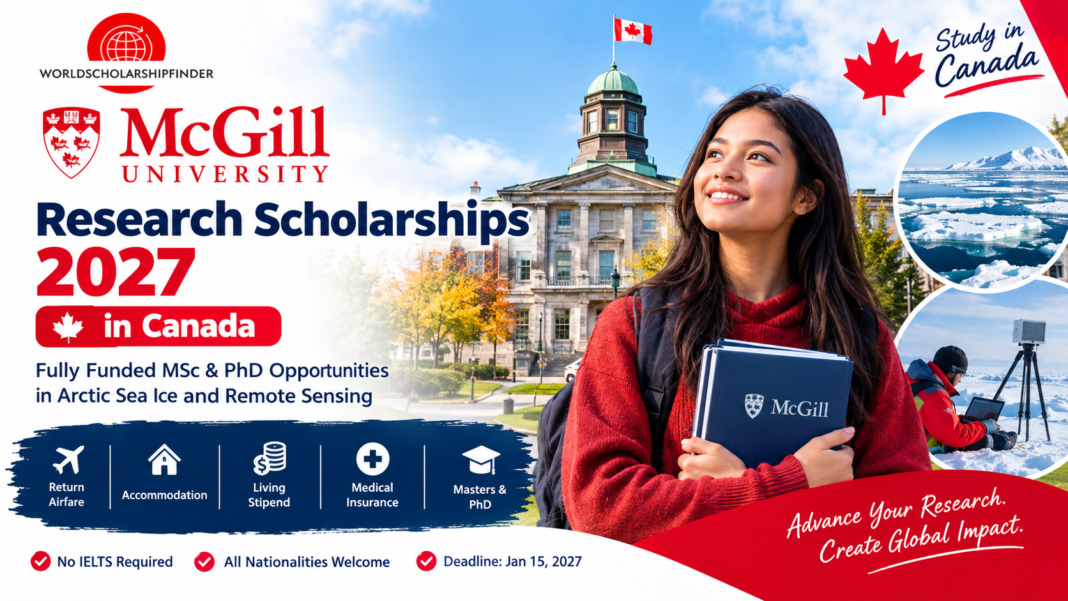
Canada Scholarships 2027: McGill University Research Scholarships for Masters and PhD
If you are looking for fully funded scholarships in Canada for 2027, McGill University has research opportunities worth exploring. The university’s Department of Geography and the Polar Remote Sensing Research Group are recruiting graduate students for research on Arctic sea ice and radar remote sensing, with MSc and PhD positions starting in Fall 2027.
According to McGill’s official research group page, the Polar Remote Sensing Research Group is recruiting at least one MSc and one PhD student, and both positions are listed as fully funded through a combination of award, research assistantship (RA), and teaching assistantship (TA) support.
These opportunities are particularly relevant to students with backgrounds in geography, remote sensing, physics, engineering, environmental science, computer science and related disciplines.
McGill University Research Scholarships 2027 – Quick Overview
| Scholarship Detail | Information |
|---|---|
| Host Country | Canada |
| University | McGill University |
| Department | Department of Geography |
| Research Group | Polar Remote Sensing Research Group |
| Study Levels | Master’s and PhD |
| Research Area | Arctic sea ice and radar remote sensing |
| Start Date | Fall 2027 |
| Funding | Fully funded MSc and PhD positions |
| Funding Structure | Award + Research Assistantship + Teaching Assistantship |
| Application Deadline | January 15, 2027 |
| Study Location | Montreal, Quebec, Canada |
McGill’s Geography Department states that complete graduate applications must be received by January 15 for guaranteed consideration, while the specific program pages list January 15 for both international and domestic applicants to the MSc and PhD in Geography.
About the McGill University Research Scholarships 2027
The opportunity is offered through the Polar Remote Sensing Research Group, led by Dr. Mallik Mahmud at McGill University.
The research group develops radar remote-sensing methods for monitoring Arctic sea ice and combines remote-sensing research with field-based Arctic research.
For Fall 2027, the group is recruiting graduate students for:
- MSc research
- PhD research
- Arctic sea-ice research
- Radar remote sensing
- Synthetic Aperture Radar (SAR)
- Geospatial and satellite-data analysis
The official laboratory page states that the available MSc and PhD positions are fully funded through Award + RA + TA support.
This makes the opportunity particularly relevant for students seeking funded graduate research opportunities in Canada.
MSc Research Position at McGill University
The MSc project will focus on SAR-based characterization of sea ice in the Canadian Arctic.
According to the research group, previous radar experience is welcome but not required for the MSc position.
MSc Eligibility
Applicants should have:
- A bachelor’s degree in geography, environmental science, physics, engineering, computer science or a related discipline.
- Strong programming skills.
- Coursework or project experience involving satellite imagery is an advantage.
- A background in remote sensing, GIS or geophysics is desirable.
- An interest in Arctic fieldwork.
The research group specifically notes that radar experience is welcome but not required for the MSc position.
Possible Research Areas
Students may work with technologies and datasets related to:
- Satellite imagery
- Synthetic Aperture Radar
- Arctic sea ice
- Remote sensing
- GIS
- Geophysics
- Environmental monitoring
- Large-scale geospatial datasets
PhD Research Position at McGill University
The PhD project will focus on radar analysis of Arctic sea ice using multi-frequency Synthetic Aperture Radar (SAR).
The position is aimed at applicants with more advanced research and technical experience.
PhD Eligibility
The research group is looking for candidates with:
- An MSc in remote sensing, geography, physics, engineering or a closely related field.
- Hands-on experience with radar data.
- Understanding of radar backscatter and polarimetry.
- Advanced programming skills.
- Experience with large raster datasets, cloud platforms or machine learning is an advantage.
- Interest in participating in Arctic field campaigns.
- Strong scientific writing skills.
- A first-author publication or manuscript in preparation is desirable.
These requirements are listed by the McGill research group for the Fall 2027 PhD opening.
What Does the Scholarship Cover?
The research group describes the Fall 2027 MSc and PhD positions as fully funded, with support provided through:
- Awards
- Research Assistantships (RA)
- Teaching Assistantships (TA)
The exact amount and structure of financial support can depend on the appointment, award and student’s circumstances. Applicants should therefore confirm the current funding package directly with the research group and McGill during the application process.
McGill’s Geography graduate information also notes that the department offers funding, fellowships and awards that can support students’ research and fieldwork.
Is IELTS Required for McGill University?
The original scholarship listing states that IELTS is not required. However, applicants should not assume that all international applicants are automatically exempt from English-language requirements.
McGill states that graduate applicants must demonstrate adequate English proficiency unless they meet one of the university’s exemption conditions.
For example, proof may not normally be required if an applicant has obtained or is obtaining a degree from a recognized institution where English is the language of instruction, or meets other specified conditions.
For applicants who do need to demonstrate proficiency, McGill currently lists:
- IELTS Academic: 6.5 or higher
- TOEFL iBT: 86 overall, with minimum component scores
- McGill’s Certificate of Proficiency in English
Program-specific requirements can be higher, so applicants should check the department’s current instructions.
Therefore, it is more accurate to say that IELTS may be waived for eligible applicants rather than advertising this opportunity as universally “No IELTS Required.”
McGill University Geography Admission Requirements
McGill’s MSc in Geography requires an eligible bachelor’s degree and English-language proficiency, with the program page currently listing a minimum 3.0 GPA on a 4.0 scale at the university level.
For the Geography PhD, McGill states that applicants normally need a bachelor’s degree and a master’s degree; the department does not normally accept applicants into the PhD without a master’s degree, although an internal fast-track route can be possible under certain circumstances.
Applicants should also review the department’s research requirements because admission to a research-based graduate program depends on the fit between the applicant’s background, proposed research and available supervision.
Application Deadline for McGill Scholarships 2027
The deadline for the McGill Geography graduate program is:
January 15, 2027
McGill’s Department of Geography states that complete applications should be received by January 15 for guaranteed consideration.
The official MSc and PhD program pages also currently list January 15 as the Fall admission deadline for international and domestic applicants.
Because deadlines can change, applicants should check the official McGill application system before submitting their application.
How to Apply for McGill University Research Scholarships 2027
The application involves both contacting the research group and completing the official McGill graduate application.
Step 1: Review the Research Opportunity
Start by reviewing the official Polar Remote Sensing Research Group page and determine whether your academic background and research interests match the MSc or PhD project.
McGill Polar Remote Sensing Research Group
Step 2: Review the Position Requirements
Carefully compare your experience with the requirements for the position.
For the PhD, particular attention should be given to radar remote sensing, SAR, programming, polarimetry and scientific research experience.
For the MSc, experience with remote sensing, GIS, satellite imagery or related areas can strengthen your application.
Step 3: Prepare Your CV
Prepare an academic CV highlighting:
- Education
- Research experience
- Programming skills
- Remote sensing experience
- Publications
- Academic projects
- Technical skills
- Relevant work experience
- Awards and scholarships
Step 4: Prepare Your Academic Transcripts
Have your academic transcripts ready according to McGill’s graduate application requirements.
Step 5: Contact the Research Group
The laboratory specifically invites prospective graduate students to apply for the Fall 2027 openings.
When contacting the potential supervisor, briefly explain:
- Your academic background
- Your research experience
- Your interest in Arctic research
- Your relevant technical skills
- Whether you are interested in the MSc or PhD position
Avoid sending a generic email. Connect your previous experience to the specific research project.
Step 6: Submit the McGill Graduate Application
McGill instructs applicants to apply through its graduate application system. The Geography Department also requires a research statement as part of the application.
McGill Graduate Applications
Step 7: Submit Before January 15, 2027
Make sure all required application components are submitted before the applicable deadline.
Documents You Should Prepare
Depending on the specific program and application instructions, applicants may need documents such as:
- Academic transcripts
- CV or résumé
- Research statement/proposal
- Letters of recommendation
- English-language proficiency documentation, if required
- Degree certificates or other academic documents
- Additional program-specific materials
McGill advises prospective graduate students to review program-specific requirements because requirements can vary between departments.
Why This Opportunity Is Relevant to Remote Sensing Students
The McGill research opportunity is particularly focused on Arctic sea ice monitoring.
The Polar Remote Sensing Research Group develops radar remote-sensing methods and conducts field-based research in the Arctic.
Students interested in the following fields may therefore find the research particularly relevant:
- Remote sensing
- Geographic Information Systems
- Environmental science
- Geography
- Geophysics
- Physics
- Engineering
- Computer science
- Satellite Earth observation
- Climate and environmental research
- Machine learning for geospatial applications
How to Make Your Application Stronger
A strong application should clearly connect your previous experience with the proposed research.
1. Highlight Relevant Technical Skills
Mention practical experience with tools or methods such as:
- Python
- GIS
- Satellite imagery
- SAR
- Remote sensing
- Raster processing
- Machine learning
- Cloud computing
Only include skills you genuinely possess.
2. Explain Your Research Interests
Your research statement should clearly explain what you want to investigate and why the research group is relevant to your academic goals.
3. Show Research Experience
If you have completed a thesis, dissertation, research project or publication, explain your contribution and the methods you used.
4. Make Your Email Specific
When contacting the research supervisor, avoid writing only:
“I am interested in your scholarship.”
Instead, briefly explain which research area interests you and how your background connects to it.
5. Prepare Early
January 15 can arrive quickly, particularly when you need recommendation letters, transcripts, language-test results or other supporting documents.
Frequently Asked Questions
Is the McGill University Research Scholarship fully funded?
The specific Fall 2027 MSc and PhD positions in the Polar Remote Sensing Research Group are listed by McGill as fully funded through Award + RA + TA support.
Who can apply?
The positions are intended for graduate applicants whose academic backgrounds match the research requirements. The MSc position accepts applicants from fields such as geography, environmental science, physics, engineering and computer science, while the PhD position requires a relevant master’s degree and stronger experience in radar remote sensing and research.
What is the application deadline?
The current McGill Geography graduate deadline is January 15, 2027 for Fall admission.
Is IELTS required?
Not necessarily. McGill provides exemptions from English-language testing for applicants who meet specified conditions. Applicants who do not qualify for an exemption may need to provide an accepted English test score.
Can international students apply?
The McGill Geography graduate program provides application deadlines for international applicants, and the program is open to eligible applicants from outside Canada. Applicants must meet the academic, English-language and program-specific requirements.
What will the MSc student research?
The MSc project focuses on SAR-based characterization of sea ice in the Canadian Arctic.
What will the PhD student research?
The PhD project focuses on radar analysis of Arctic sea ice using multi-frequency SAR.
Does the opportunity include undergraduate scholarships?
The specific Fall 2027 openings discussed here are graduate positions. The research group may have other opportunities, but applicants should not assume that the MSc/PhD funding automatically applies to undergraduate students.
Official Application and Information
For the most accurate and current information, applicants should use McGill’s official sources rather than third-party scholarship listings.
McGill Polar Remote Sensing Research Group – Join the Lab
McGill Department of Geography – Graduate Program
McGill MSc in Geography Admissions
McGill PhD in Geography Admissions
McGill English Language Proficiency Requirements
Related Scholarships on World Scholarship Finder
Students searching for opportunities in Canada can also explore our guides on:
- Canada Scholarships for International Students
- Fully Funded Scholarships for International Students
- Scholarships Without IELTS
- Fully Funded Scholarships for African Students
- Scholarships for International Students by Country 2027
- Fully Funded Master’s Scholarships
- Fully Funded PhD Scholarships
Conclusion
The McGill University Research Scholarships 2027 provide a specific opportunity for graduate students interested in Arctic sea ice and radar remote sensing. The Polar Remote Sensing Research Group is currently advertising fully funded MSc and PhD positions beginning in Fall 2027, with funding structured through awards, research assistantships and teaching assistantships.
Applicants should carefully review the research requirements, confirm their English-language requirements, contact the research group where appropriate, and complete the McGill Geography graduate application by January 15, 2027.
The opportunity is particularly suited to students with backgrounds in remote sensing, geography, environmental science, physics, engineering, computer science and related research fields.

